


On the Optimal Number of Grids for Differentially Private Non-Interactive K-Means Clustering
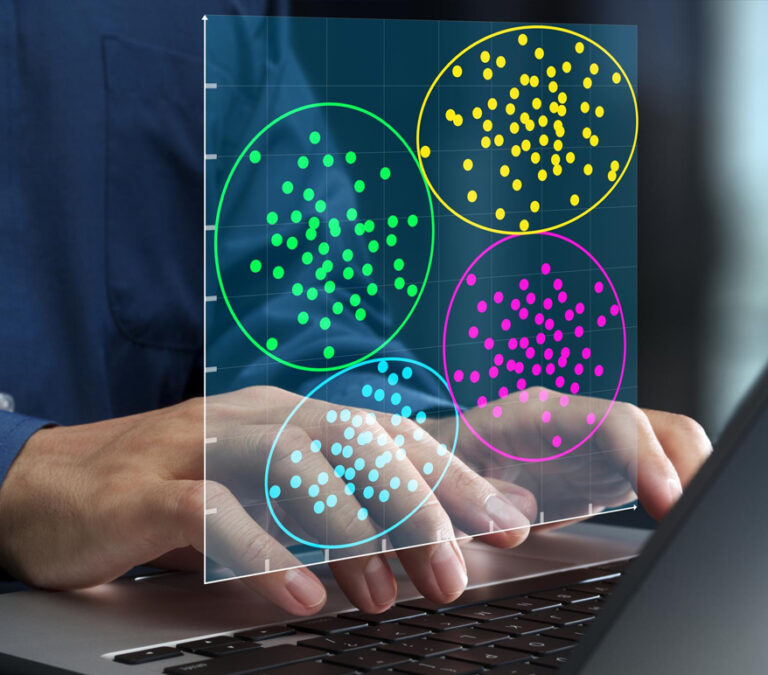
On the Optimal Number of Grids for Differentially Private Non-Interactive K-Means Clustering Authors: Gokularam M, Anshoo Tandon Differentially private K-means clustering enables releasing cluster centers derived from a dataset while protecting the privacy of the individuals. Non-interactive clustering techniques based on privatized histograms are attractive because the released data synopsis can be reused for other downstream tasks without additional privacy loss. …
Continue Reading
SKALD: Scalable K-Anonymisation for Large Datasets
SKALD: Scalable K-Anonymisation for Large Datasets Authors:K. Reddy, N. Chakraborty, A. Dharmavaram, A. Tandon Data privacy and anonymisation are critical concerns in today’s data-driven society, particularly when handling personal and sensitive user data. Regulatory frameworks worldwide recommend privacy-preserving protocols such as k-anonymisation to de-identify releases of tabular data. Available hardware resources provide an upper bound on the maximum size of …
Continue Reading
Improving the Privacy Loss Under User-Level DP Composition for Fixed Estimation Error
Improving the Privacy Loss Under User-Level DP Composition for Fixed Estimation Error Authors:V. A. Rameshwar and A. Tandon This paper considers the private release of statistics of several disjoint subsets of a datasets. In particular, we consider the epsilon-user-level differentially private release of sample means and variances of sample values in disjoint subsets of a dataset, in a potentially sequential manner. …
Continue Reading
ℓ, 𝛿)-Diversity: Linkage-Robustness via a Composition Theorem
ℓ, 𝛿)-Diversity: Linkage-Robustness via a Composition Theorem Authors:V. A. Rameshwar and A. Tandon In this paper, we consider the problem of degradation of anonymity upon linkages of anonymized datasets. We work in the setting where an adversary links together tgeq 2 anonymized datasets in which a user of interest participates, based on the user’s known quasi-identifiers, which motivates the use of ell-diversity as …
Continue Reading
Bounding User Contributions for User-Level Differentially Private Mean Estimation
Bounding User Contributions for User-Level Differentially Private Mean Estimation Authors: V. Arvind Rameshwar (IIT Madras) and Anshoo Tandon We revisit the problem of releasing the sample mean of bounded samples in a dataset, privately, under user-level ε-differential privacy (DP). We aim to derive the optimal method of preprocessing data samples, within a canonical class of processing strategies, in terms of the …
Continue Reading
On the Optimal Number of Grids for Differentially Private Non-Interactive K-Means Clustering – Data Privacy
On the Optimal Number of Grids for Differentially Private Non-Interactive K-Means Clustering – Data Privacy Authors: Gokularam M, Anshoo Tandon Differentially private K-means clustering enables releasing cluster centers derived from a dataset while protecting the privacy of the individuals. Non-interactive clustering techniques based on privatized histograms are attractive because the released data synopsis can be reused for other downstream tasks …
Continue Reading
Breaking Data Silos: How GDI is Transforming Access to Geospatial Information in India
-
CDPG
-
October 27, 2025
-
Data Privacy
-
0 Comments
Breaking Data Silos: How GDI is Transforming Access to Geospatial Information in India Authors: Bryan Paul Robert, Mahidhar Chellamani, Jyotirmoy Dutta For years, some of India’s most valuable geospatial datasets remained scattered across government departments, research institutes, or private organizations. They held immense potential to transform logistics, strengthen climate resilience, and support smarter urban planning, but they remained difficult to …
Continue Reading
Adaptive Self-Distillation for Minimizing Client Drift in Heterogeneous Federated Learning
-
CDPG
-
February 7, 2025
-
Data Privacy
-
0 Comments
Adaptive Self-Distillation for Minimizing Client Drift in Heterogeneous Federated Learning Authors: M. Yashwanth, G. K. Nayak, A. Singh, Y. Simmhan, A. Chakraborty Federated Learning (FL) is a machine learning paradigm that enables clients to jointly train a global model by aggregating the locally trained models without sharing any local training data. In practice, there can often be substantial heterogeneity (e.g., …
Continue Reading
Privacy-Preserving Data Quality Assessment for Time-Series IoT Sensors
-
CDPG
-
February 7, 2025
-
Data Privacy
-
0 Comments
Privacy-Preserving Data Quality Assessment for Time-Series IoT Sensors Authors: N. Chakraborty, A. Sharma, J. Dutta. H. D. Kumar This paper proposes a novel framework for automated, objective, and privacy-preserving data quality assessment of time-series data from IoT sensors deployed in smart cities. We leverage custom, autonomously computable metrics that parameterise the temporal performance and adherence to a declarative schema document …
Continue Reading
Building a Privacy Web with SPIDEr – Secure Pipeline for Information De-Identification with End-to-End Encryption
-
CDPG
-
February 3, 2025
-
Data Privacy
-
0 Comments
Building a Privacy Web with SPIDEr – Secure Pipeline for Information De-Identification with End-to-End Encryption Authors: N. Chakraborty, A. Tandon, K. Reddy, K. Kirpekar, B. Robert, H. Kumar, A. Venkatesh, A. Sharma Data de-identification makes it possible to glean insights from data while preserving user privacy. The use of Trusted Execution Environments (TEEs) allow for the execution of de-identification applications …
Continue Reading